


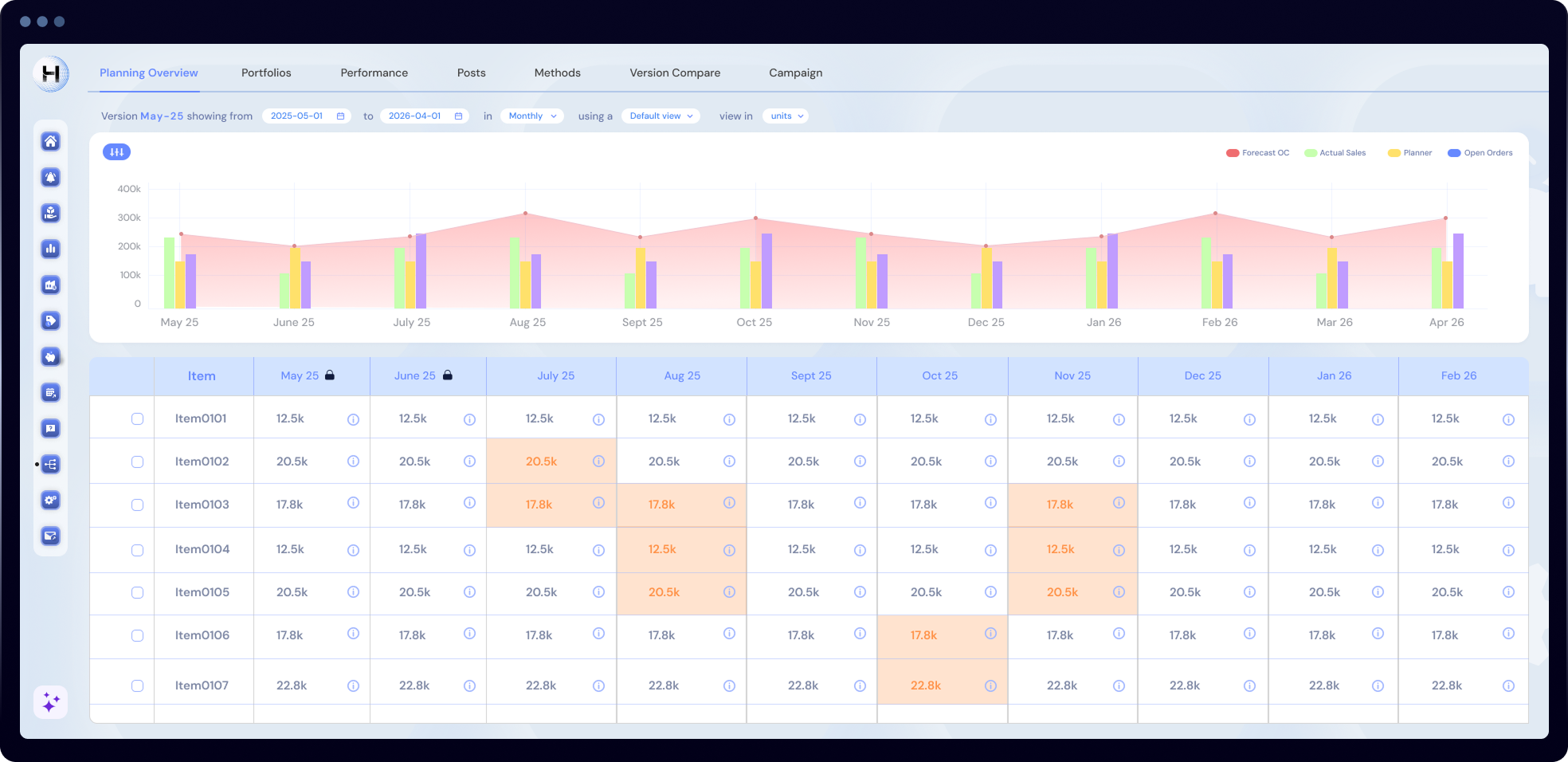
Improve Forecast Accuracy
Align teams faster and spend less time maintaining spreadsheets.
How It Works
Horizon Demand Planning
.svg)
Transparent baseline

Use ML, statistical, and ensemble models with full visibility into how forecasts are built.

Demand sensing
React to shifts in demand and learn automatically from past events and promotions.
.svg)
Collaboration tracking
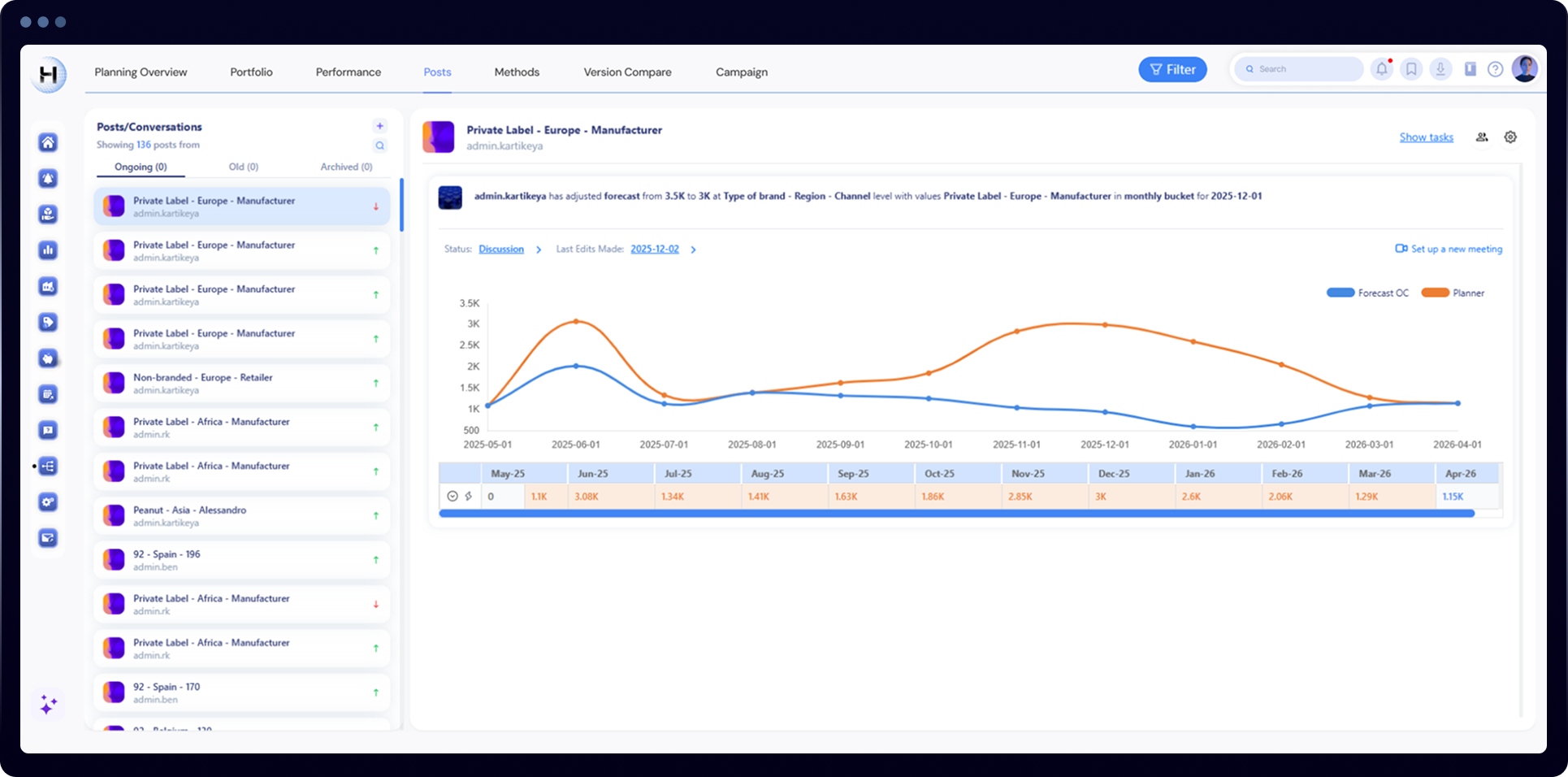
Collect and track inputs from all departments with full change history.

Portfolio flexibility
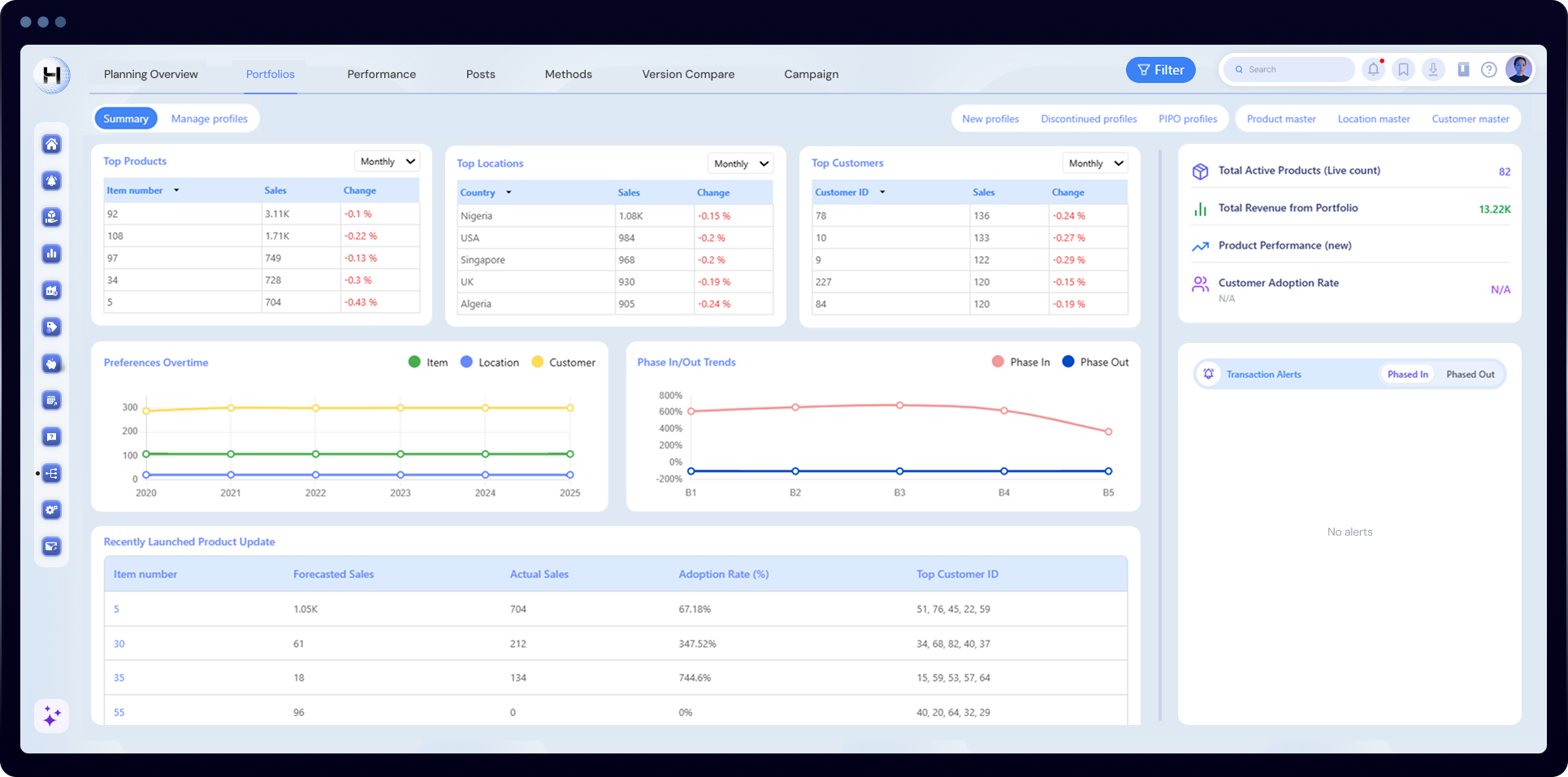
Manage phase-ins and phase-outs easily at any Item or brand level

Forecast value tracking
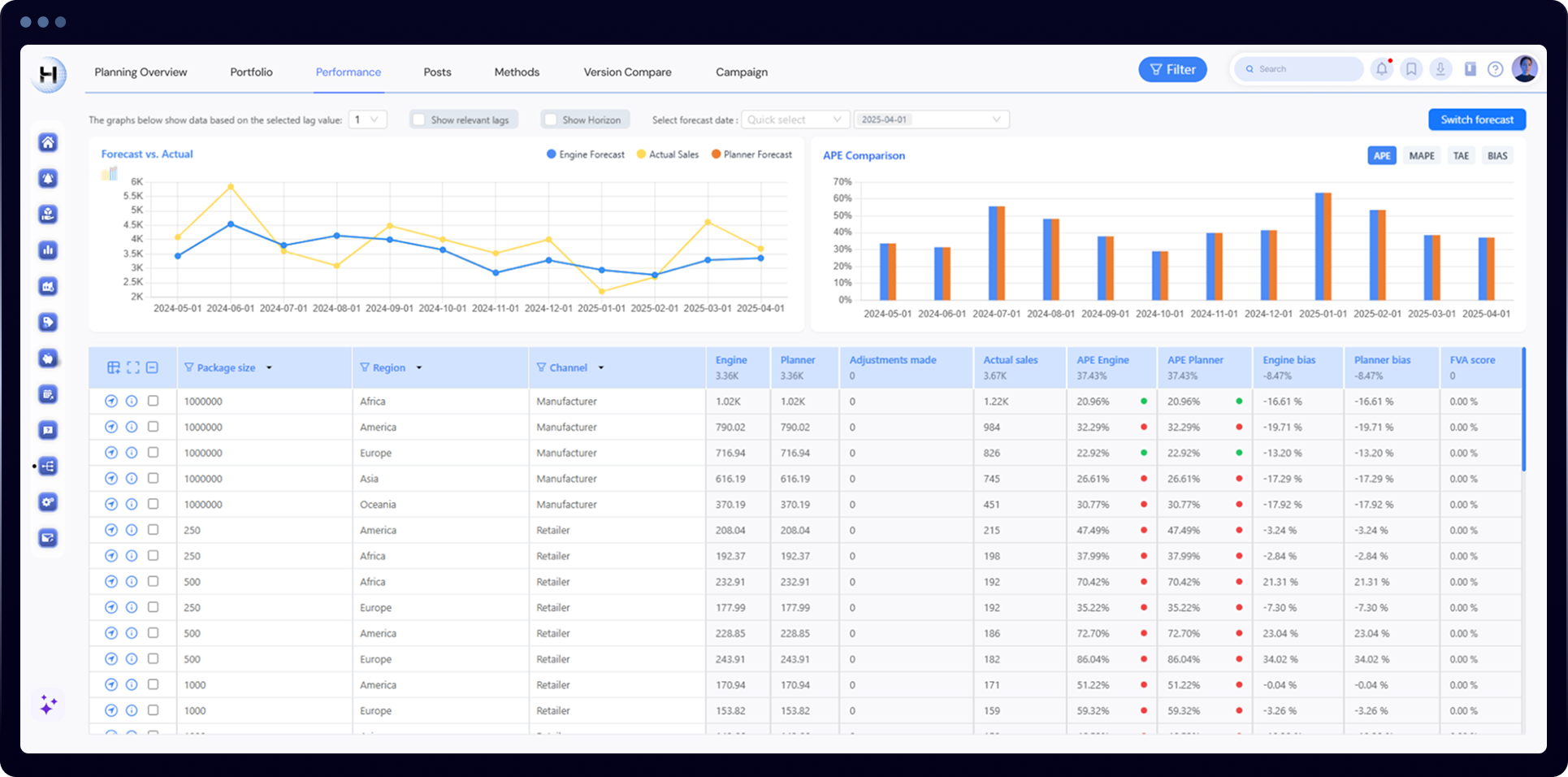
Measure forecast value add (FVA) and see where overrides improved accuracy.

Horizon AI assistant
Use text or voice to explore drivers, adjust forecasts, or get instant insights.
Intelligent Planning, Made Practical
Designed for planners who need speed, clarity, and control.
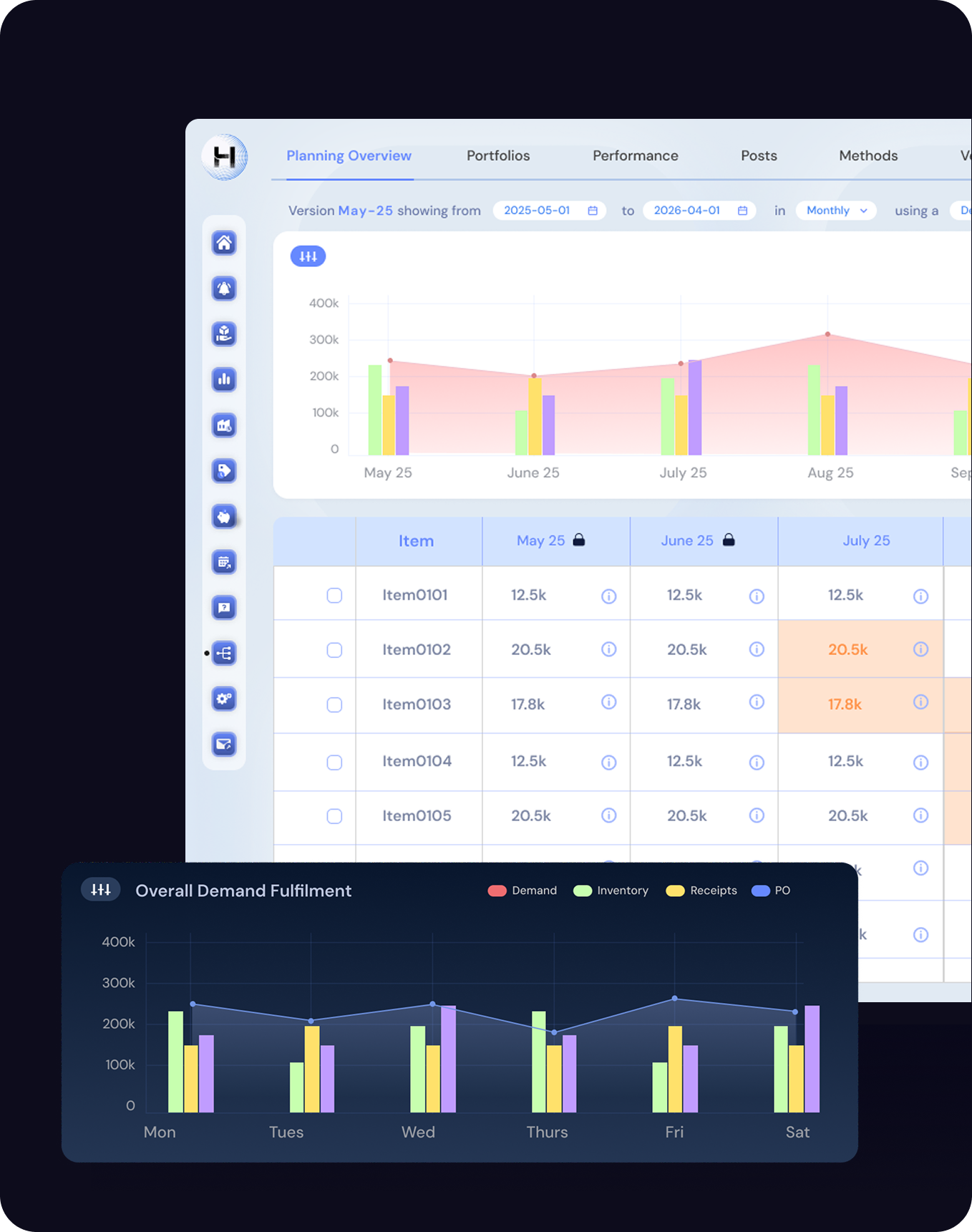



Intuitive Demand Planning frontend
Get quick insights on workspaces made just for planners.


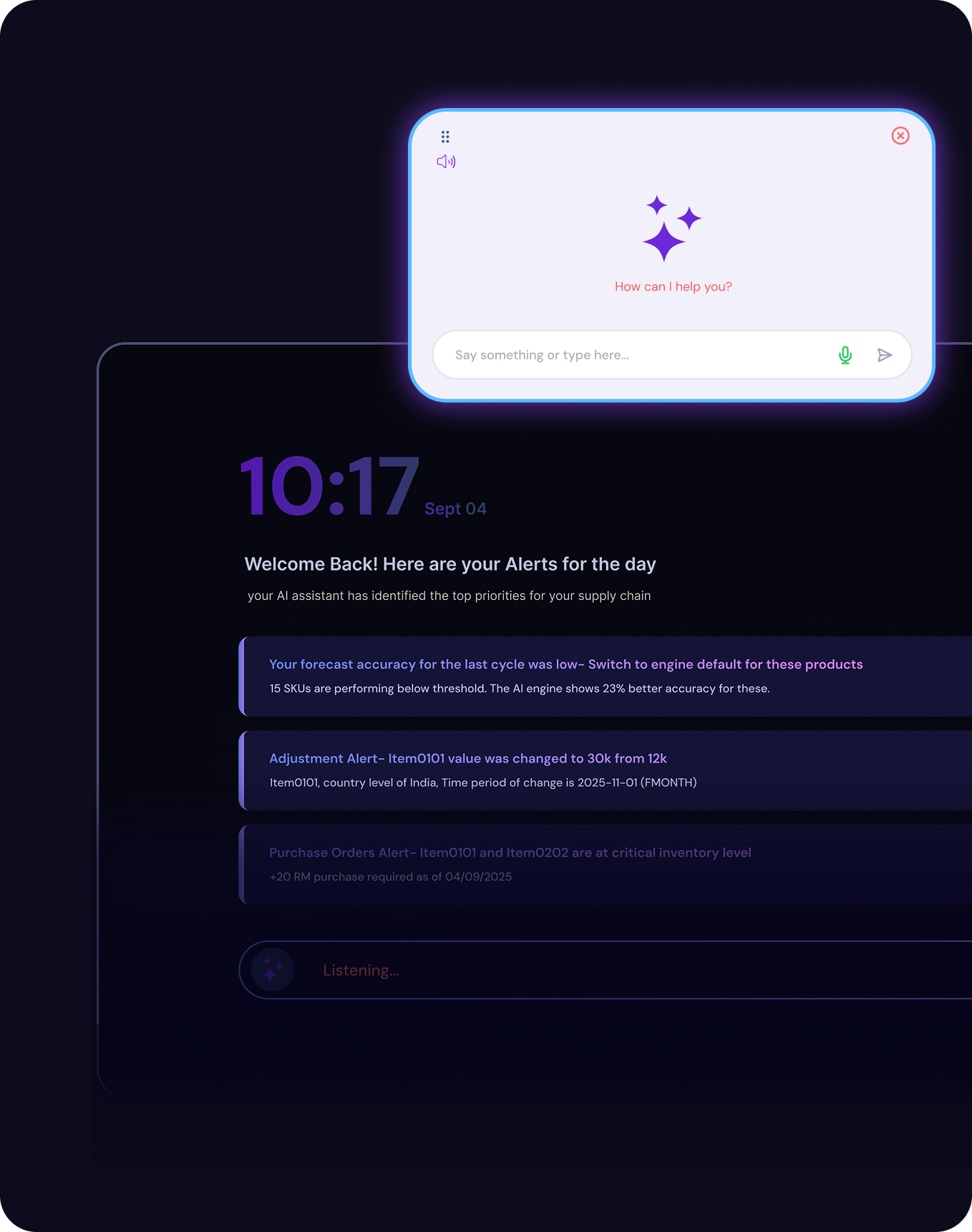
Talk to the Horizon AI assistant
Talk to Horizon assistant and clear up any doubts.


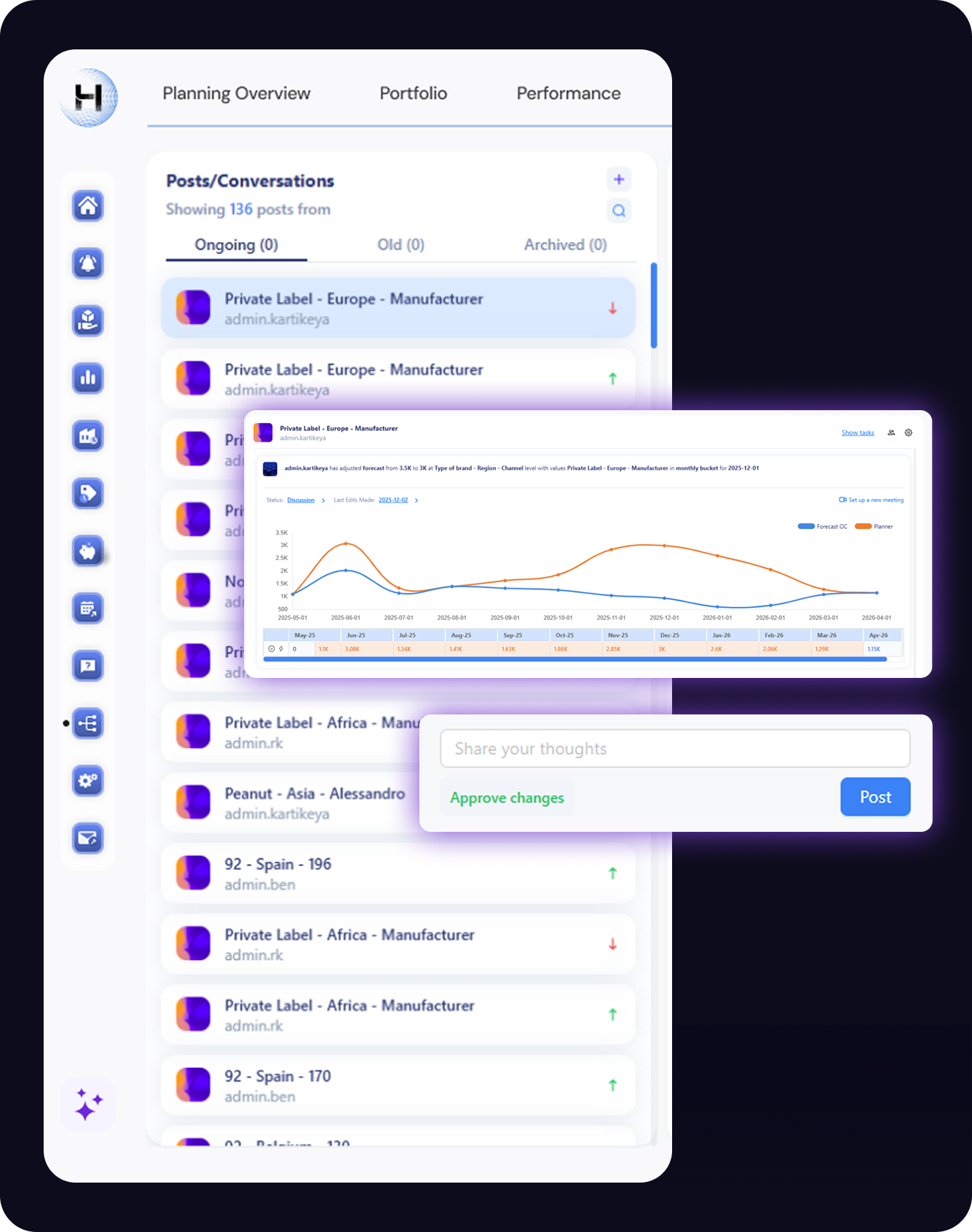
Collaboration
Discuss and make changes, collaborate, and decide faster.
Next-Gen Planning
Smarter features, built for planners
Planning workspace, portfolio details, tracking, and performance metrics.


Smart modeling
Horizon always tests different models on the latest data to deliver the best possible forecast.
.svg)
Automation
Receive alerts for outliers and large errors, and work on a priority-only basis.
.svg)
Flexible or freeze
Easily set which forecasts can be changed by other people, and have the changes tracked everywhere.
.svg)
Roles
Different access levels for planners and salespeople.
Planners' Voices
What planning leaders say
Real experiences from planners and leaders.
"Impressed by the knowledge and fast results of Horizon.
Together we turned plans into action in no time."
Together we turned plans into action in no time."

Olivier Van Hoef –
Supply chain manager at Ahrend
Supply chain manager at Ahrend
"After 40+ years of implementing different planning tools, Horizon is by far the easiest to set up and adapt. It combines strong models with a flexibility we haven’t seen elsewhere."

Alex Young –
Director at Demand Integration
Director at Demand Integration
“What stood out was how quickly our team could use Horizon and how easily it was integrated with our current systems: the planning team saw the impact on their day-to-day immediately, and it improved collaboration and decision-making from a management perspective.”

Siddhant Bhalinge –
CEO at Ugaoo
CEO at Ugaoo
FAQ
Frequently Asked Questions
Find quick answers to the most common questions about Demand Planning.
What is demand planning, and why does it matter in supply chain management?

Demand planning is the process of predicting what customers will need, when, and where so your supply chain can respond without overproducing or running short.
It goes beyond just sales forecasting by diving deeper into Item-Location level insights, helping companies:
Anticipate demand changes caused by seasonality, promotions, and market shifts.
Align production, procurement, and inventory with real demand patterns.
Avoid lost sales or excess inventory that ties up capital.
While a sales forecast looks at revenue targets, demand planning focuses on units and timing ensuring operations stay synchronized with market needs.
It’s the bridge between financial goals and operational execution.
It goes beyond just sales forecasting by diving deeper into Item-Location level insights, helping companies:
Anticipate demand changes caused by seasonality, promotions, and market shifts.
Align production, procurement, and inventory with real demand patterns.
Avoid lost sales or excess inventory that ties up capital.
While a sales forecast looks at revenue targets, demand planning focuses on units and timing ensuring operations stay synchronized with market needs.
It’s the bridge between financial goals and operational execution.
What are the key steps involved in a strong demand planning process?
A robust demand planning process blends data, collaboration, and analytics.
Here’s how leading organizations typically approach it:
Data collection: Pulling sales, orders, and shipment history from ERP or CRM systems.
Data cleaning: Removing outliers and adjusting for promotions, stockouts, or unusual events.
Portfolio management: Incorporating new product launches (NPI) and managing product phase-outs.
Forecast creation: Applying statistical or ML-based models to generate forecasts at the right aggregation level.
Collaboration: Aligning with sales, marketing, and finance to capture market intelligence.
Performance tracking: Measuring accuracy, forecast value add (FVA), and continuously refining models.
Integration with S&OP or IBP: Ensuring the demand plan aligns with supply, financial, and business strategies. Effective demand planning isn’t just about predicting it’s about continuously improving how those predictions drive smarter decisions.
Here’s how leading organizations typically approach it:
Data collection: Pulling sales, orders, and shipment history from ERP or CRM systems.
Data cleaning: Removing outliers and adjusting for promotions, stockouts, or unusual events.
Portfolio management: Incorporating new product launches (NPI) and managing product phase-outs.
Forecast creation: Applying statistical or ML-based models to generate forecasts at the right aggregation level.
Collaboration: Aligning with sales, marketing, and finance to capture market intelligence.
Performance tracking: Measuring accuracy, forecast value add (FVA), and continuously refining models.
Integration with S&OP or IBP: Ensuring the demand plan aligns with supply, financial, and business strategies. Effective demand planning isn’t just about predicting it’s about continuously improving how those predictions drive smarter decisions.
How do AI and machine learning improve demand planning and forecasting?
AI and machine learning make demand planning more intelligent and responsive by learning from data patterns that traditional models might miss.
Here’s where they add value:
Detect anomalies: Identify unexpected spikes or dips in demand early.
Learn from external drivers: Factor in economic trends, weather, and even marketing campaigns.
Understand sales context: Analyze CRM notes and qualitative inputs from sales teams.
Automate updates: Continuously refresh forecasts as new data streams in, making plans more adaptive. Rather than replacing human planners, AI acts as a co-pilot amplifying their decision-making power and giving them real time visibility into changing market dynamics.
Here’s where they add value:
Detect anomalies: Identify unexpected spikes or dips in demand early.
Learn from external drivers: Factor in economic trends, weather, and even marketing campaigns.
Understand sales context: Analyze CRM notes and qualitative inputs from sales teams.
Automate updates: Continuously refresh forecasts as new data streams in, making plans more adaptive. Rather than replacing human planners, AI acts as a co-pilot amplifying their decision-making power and giving them real time visibility into changing market dynamics.
How can Horizon improve forecast accuracy and collaboration?
Good demand planning software transforms planning from a manual process into a data-driven, collaborative workflow.
Here’s how it helps:
Automated forecasting: Uses historical data and AI models to produce reliable baseline forecasts.
Smart alerts: Detects outliers or sudden shifts in sales trends.
Change tracking: Keeps a record of planner overrides for transparency and accountability.
Team collaboration: Allows planners, sales, and finance to align on a single, real-time plan.
Scenario Planning: Scenario Planning let users test multiple demand scenarios instantly.
Integration: Connects seamlessly with ERP, inventory, and supply planning systems. The result? Fewer surprises, faster consensus, and more confidence in every forecast.
Here’s how it helps:
Automated forecasting: Uses historical data and AI models to produce reliable baseline forecasts.
Smart alerts: Detects outliers or sudden shifts in sales trends.
Change tracking: Keeps a record of planner overrides for transparency and accountability.
Team collaboration: Allows planners, sales, and finance to align on a single, real-time plan.
Scenario Planning: Scenario Planning let users test multiple demand scenarios instantly.
Integration: Connects seamlessly with ERP, inventory, and supply planning systems. The result? Fewer surprises, faster consensus, and more confidence in every forecast.
How does Horizon enhance demand planning and forecasting for businesses?
Horizon is built to help companies plan demand with precision and confidence combining AI-driven insights, advanced forecasting models, and seamless collaboration tools.
Here’s what makes it stand out:
Smart forecasting engine: Automatically selects the best-fit statistical or machine learning model based on product behavior.
Collaborative workflows: Sales, finance, and planners work together on one live platform no version chaos.
Proactive recommendations: Horizon flags risks, forecast variances, and opportunities for adjustment.
Custom flexibility: Planners can adjust models, override forecasts, and tailor parameters to their business.
Full transparency: Every change is logged for accountability and auditability. In short, Horizon gives planners AI-level precision with human-level control creating forecasts that are both data-backed and business-ready.
Here’s what makes it stand out:
Smart forecasting engine: Automatically selects the best-fit statistical or machine learning model based on product behavior.
Collaborative workflows: Sales, finance, and planners work together on one live platform no version chaos.
Proactive recommendations: Horizon flags risks, forecast variances, and opportunities for adjustment.
Custom flexibility: Planners can adjust models, override forecasts, and tailor parameters to their business.
Full transparency: Every change is logged for accountability and auditability. In short, Horizon gives planners AI-level precision with human-level control creating forecasts that are both data-backed and business-ready.

Horizon Solutions empowers you to plan smarter, stay in control, and drive confident supply-chain decisions.



© 2026 Horizon Solutions. All rights reserved.