AI in demand planning: How artificial intelligence improves forecasting
Introduction: the complexity of demand planning
Demand planning means juggling hundreds or thousands of products (SKUs), many locations and a customer base that keeps shifting. That complexity makes the search for an effective, usable demand planning system harder, and more important.
The inevitable question: how does it work, exactly?
However easy a system is to use, the question about the logic behind it always comes. Why does it produce this forecast and not another? People ask for different reasons:
- Curiosity and learning: planners want to understand the system they work with every day.
- A sense of threat: an automated forecast can feel like a verdict on the spreadsheet and the judgement that came before it.
- Past misses: a history of inaccurate forecasts breeds a healthy wish to understand, and sometimes to distrust, the system.
These are legitimate concerns. Understanding the why and the how behind a forecast is not a matter of curiosity alone; it is an operational necessity.
The problem of the black box
As long as the forecasts are accurate, most people don't ask how they were made. The moment accuracy dips, even those who were indifferent start to question the inner workings.
A black box can deliver accurate forecasts and still fail to keep the organisation's trust. Transparency is what builds and sustains confidence in the system, and it has to be there before the first bad month, not after.
Explainable AI: a spectrum of understanding
Explainable AI (XAI) is about making the AI's reasoning visible, but the right level of explanation depends on who is asking:
- For the general reader: a plain account of the principles and the outcome, without the technical detail.
- For the business user: how the forecast connects to the drivers, assumptions and risks & opportunities they recognise from their own business.
- For the expert: the full technical picture, for people who want to see the models, the backtests and the settings.
Each level serves a different need. A good system answers all three without making the planner choose.
Why explainability matters in demand planning
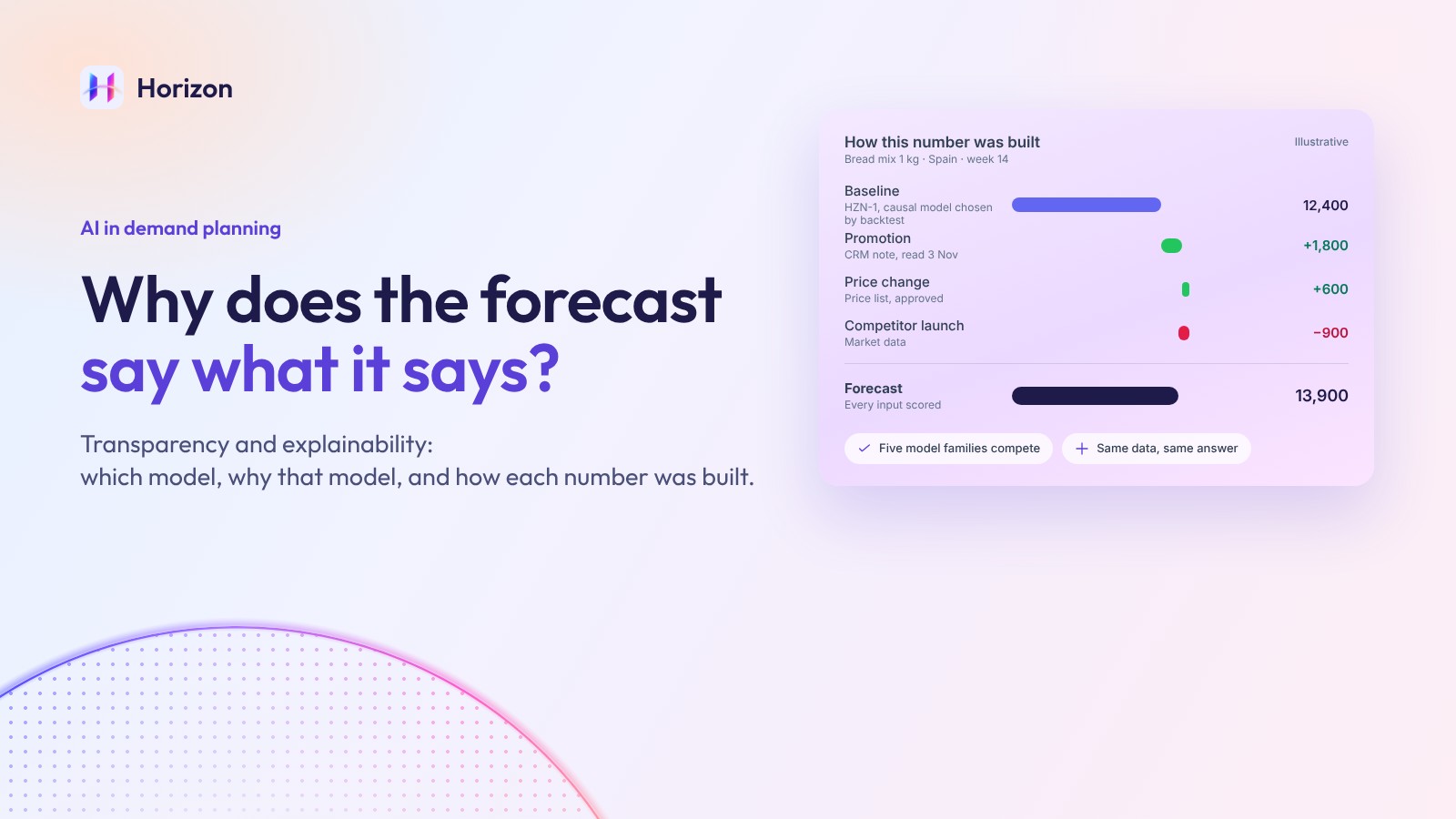
Different product categories need different forecasting models. It is not enough to pick the right model for each one; the system also has to be able to say why that model was chosen. Just as important is to show what each number is made of: the baseline, and what every signal added or took away.
That transparency does two things. It builds trust in the recommendation, and it lets planners read the reasoning behind forecasts for different categories and regions, so the models stay aligned with the business and the market rather than drifting away from them.
How Horizon does it
In Horizon, the forecast engine is HZN-1. Five model families compete, statistical, machine learning, deep learning, foundation models and causal models, and the best combination wins per item, chosen by backtest. Model choice and settings are tuned automatically per item, and the engine is deterministic: same data, same answer. You can always dig deeper and see why a given model was used for a category, and learn more about the patterns and trends behind certain types of products or regions.
With Deep Sensing on top, the explanation goes one step further. Deep Sensing reads everything that moves your demand, models the impact, and hands your planners only the decisions that matter. Every input that changed a number is shown with its source, a CRM note, a customer email, a price change, so a planner can see not just which model produced the forecast, but which signals moved it, and by how much.
Conclusion: complexity with clarity
Demand planning systems have to handle a vast range of products and shifting market conditions, and they have to be transparent while doing it. Explainable AI bridges that gap: clarity about the reasoning, tailored to the person asking. That balance of complexity and clarity is what makes a demand planning system dependable, efficient and trusted.